
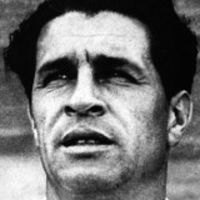
Ernie Toshack

- Jasprit Bumrah
- Ravindra Jadeja
- Yashasvi Jaiswal
- Virat Kohli
- Kuldeep Yadav
- Mohammed Siraj
- KL Rahul
- Rohit Sharma
- Shubman Gill
- Suryakumar Yadav
Alphabetically sorted top ten of players who have played the most matches across formats in the last 12 months
Full Name
Ernest Raymond Herbert Toshack
Born
December 08, 1914, Cobar, New South Wales
Died
May 11, 2003, Bobbin Head, Sydney, New South Wales, (aged 88y 154d)
Also Known As
The Black Prince, Johnson
Batting Style
Right hand Bat
Bowling Style
Left arm Medium
Wisden obituary
Ernie Toshack was one of the game's most captivating characters. Tall, with striking, rugged features, he was known to his team-mates as The Black Prince (Sid Barnes enviously dubbed him The Film Star), having earlier, in his boxing days, been called `Johnson' for his swarthiness (the American black heavyweight Jack Johnson ruled the boxing world just before Toshack was born).
Son of a stationmaster, Ernest Raymond Herbert Toshack was born in the New South Wales bush town of Cobar on December 8, 1914, and was orphaned when a boy. He was cared for by relatives in Lyndhurst, and played his early cricket and rugby league for Cowra. It was not until he was 30 that he ventured to Sydney, having already played for the State Colts and 2nd XI. A fastish left-arm bowler at that time, he first approached Petersham, the club for which he qualified residentially, "but they didn't want to know me". So he joined Marrickville, quickly rising to first-grade.
Wheelchair-bound for months after a ruptured appendix in 1938, he was rejected for war service, so worked instead at the Lithgow Small Arms factory, in the Blue Mountains near Sydney. He was chosen for NSW as soon as the war ended and was quickly among the wickets. In March 1946, after seven matches for the state, he found himself opening the bowling for Australia with Ray Lindwall in a match at Wellington which was not recognised as a Test until a couple of years afterwards. New Zealand were routed in two days on a damp pitch, and Toshack came away with 4 for 12 and 2 for 6.
Against England in 1946-47, slowing down to exploit another tacky surface, and closely supervised by skipper Don Bradman, he had match figures of 9 for 99 at the Gabba in the first Test, but in the remaining four he only once took more than one wicket in an innings, his stamina in the Adelaide Test (5 for 135 off 66 eight-ball overs in great heat) impressed everyone. With his accuracy (mainly from over the wicket), pace-change, and movement either way, to a strong leg-side field, he was hard to get away, and achieved his successes in a style not unlike Derek Underwood's a generation later.
A damaged knee was a constant hindrance, but he was passed fit for the 1948 tour of Britain, which was to guarantee him a kind of immortality as a member of Bradman's Invincibles. Tiring of signing autograph sheets during the voyage, he entrusted a friend with the task. A consequence is that there are still sheets in circulation with his name mis-spelt as Toshak.
Toshack enjoyed the tour, where he became a great drinking friend of John Arlott. He was one of seven of the Australians who took 50 or more wickets, and he fluked a heady Test average of 51 (his aggregate in four innings), below only Morris, Barnes, Bradman and Harvey. The 20 not out he managed in the Lord's Test - his highest first-class score, made in a riotous tenth-wicket stand with Bill Johnston - gave him almost as much pleasure as his 5 for 40, which finished England off. Between the new-ball blitzes of Ray Lindwall, Keith Miller and Johnston every 55 overs, Toshack was the key element in tying England down. Nowhere was this ability better shown than in the Sussex match, when his 17 overs yielded only three scoring strokes. Against a decent line-up he bowled 32 overs in the match while conceding 29 runs.
At Bramall Lane, Sheffield, he recorded the best figures of his 48-match career - 7 for 81 off 40 successive strangling overs - bemusing the Yorkshire crowd with his distinctive `Ow Wizz Ee?!' appeal. When Toshack took 6 for 51 off 27 overs against MCC at Lord's, it was considered by Bradman to be his best performance of all. If only his fascinating duel with Denis Compton had been caught on film.
Toshack's harmless sense of fun was often on show. He would don a bowler hat, grab a furled umbrella, and shove a large cigar in his mouth, pretending to be a Pom. And when a Surrey member spotted him idly playing with a bread roll over lunch and asked him what would happen if he bowled it to Bradman, Toshack's instant reply was: "He'd hit it clean over the bakery, I expect."
His knee went in the fourth Test, the celebrated match when Australia hit 404 for 3 to win, and he played little after that. He underwent a cartilage operation in London, and by the start of the 1949-50 season, when he took nine wickets in the Shield match at Brisbane, a back injury made it all too painful, and a meteoric career was suddenly spent.
In later years, he was glad to welcome visitors to his home in Sydney's northern suburbs with a beer and a chuckle and a glance through his scrapbook, though he lost touch with his old team-mates until the 1998 round of Invincibles reunions. Toshack leaves a wife, Kathleen, a daughter, and several grandchildren, and with his passing, only eight of the original 17 Invincibles remain.
Wisden Cricketer's Almanack
Ernie Toshack Career Stats
Batting & Fielding
| Format | Mat | Inns | NO | Runs | HS | Ave | 100s | 50s | 6s | Ct | St |
|---|---|---|---|---|---|---|---|---|---|---|---|
| Tests | 12 | 11 | 6 | 73 | 20* | 14.60 | 0 | 0 | 0 | 4 | 0 |
| FC | 48 | 45 | 13 | 185 | 20* | 5.78 | 0 | 0 | - | 10 | 0 |
Bowling
| Format | Mat | Inns | Balls | Runs | Wkts | BBI | BBM | Ave | Econ | SR | 4w | 5w | 10w |
|---|---|---|---|---|---|---|---|---|---|---|---|---|---|
| Tests | 12 | 23 | 3140 | 989 | 47 | 6/29 | 11/31 | 21.04 | 1.88 | 66.8 | 2 | 4 | 1 |
| FC | 48 | - | 11901 | 3973 | 195 | 7/81 | - | 20.37 | 2.00 | 61.0 | - | 12 | 1 |
Records of Ernie Toshack
Explore Statsguru Analysis
Recent Matches of Ernie Toshack
| Match | Bat | Bowl | Date | Ground | Format |
|---|---|---|---|---|---|
| NSW vs West Aust | 2* & 5 | 4/68 | 04-Nov-1949 | Sydney | FC |
| NSW vs Queensland | 1 & 1 | 4/41 & 5/59 | 28-Oct-1949 | Brisbane | FC |
| Australians vs Lancashire | 2 | 0/17 | 07-Aug-1948 | Manchester | FC |
| Australia vs England | 12* | 1/112 | 22-Jul-1948 | Leeds | Test # 302 |
| Australia vs England | 0* | 2/75 & 1/26 | 08-Jul-1948 | Manchester | Test # 301 |
Debut/Last Matches of Ernie Toshack
Test Matches
FC Matches